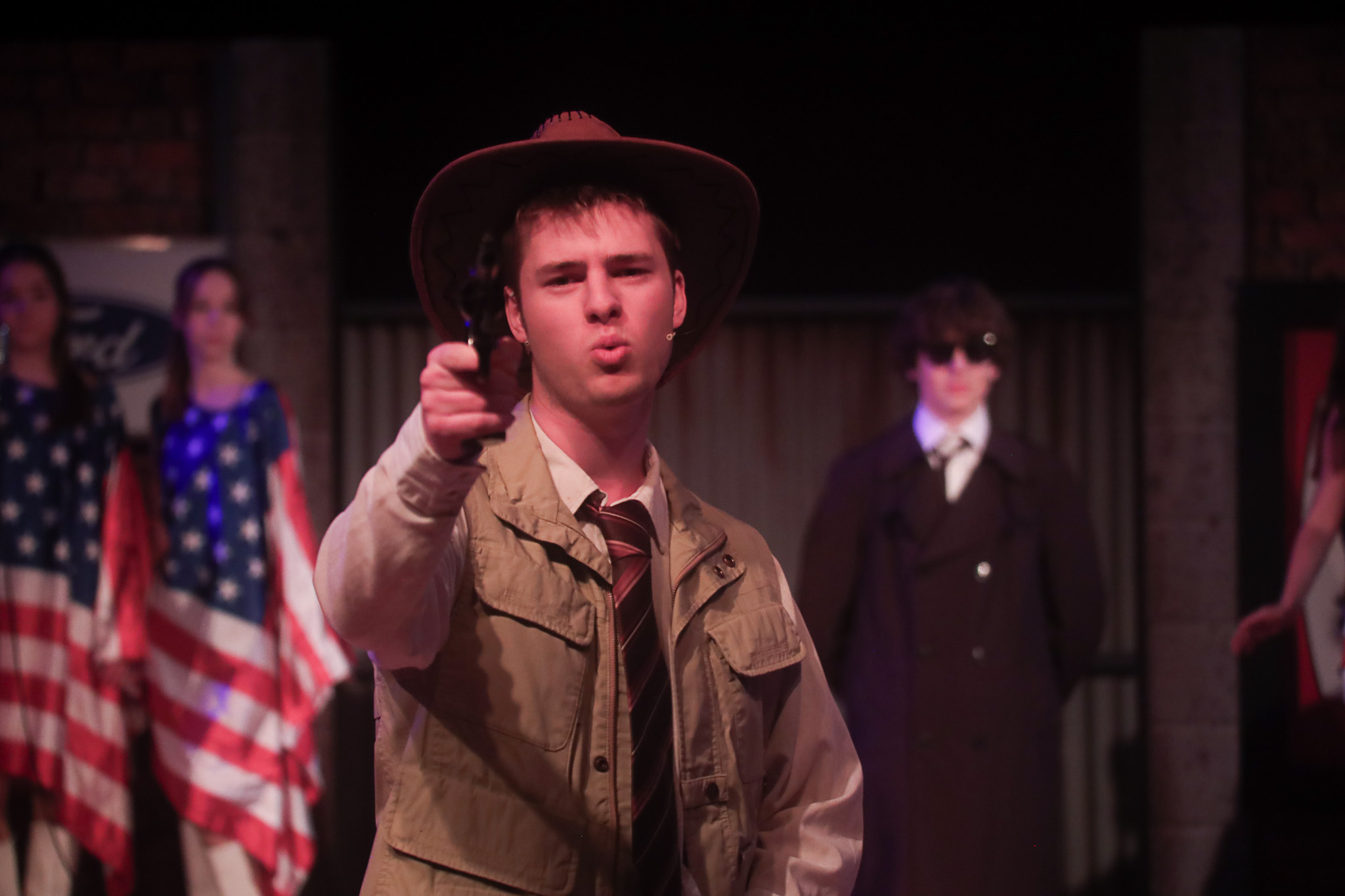
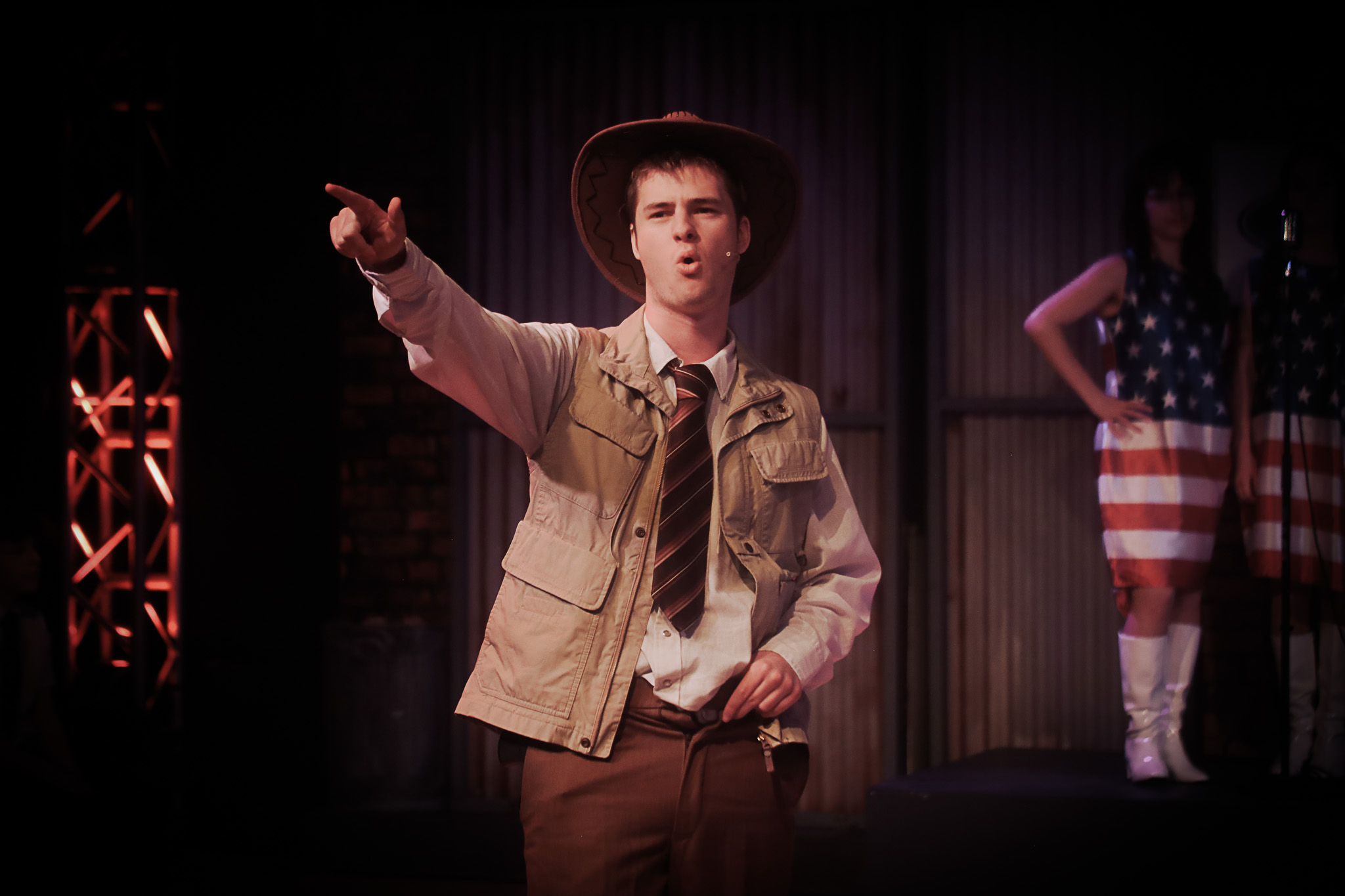
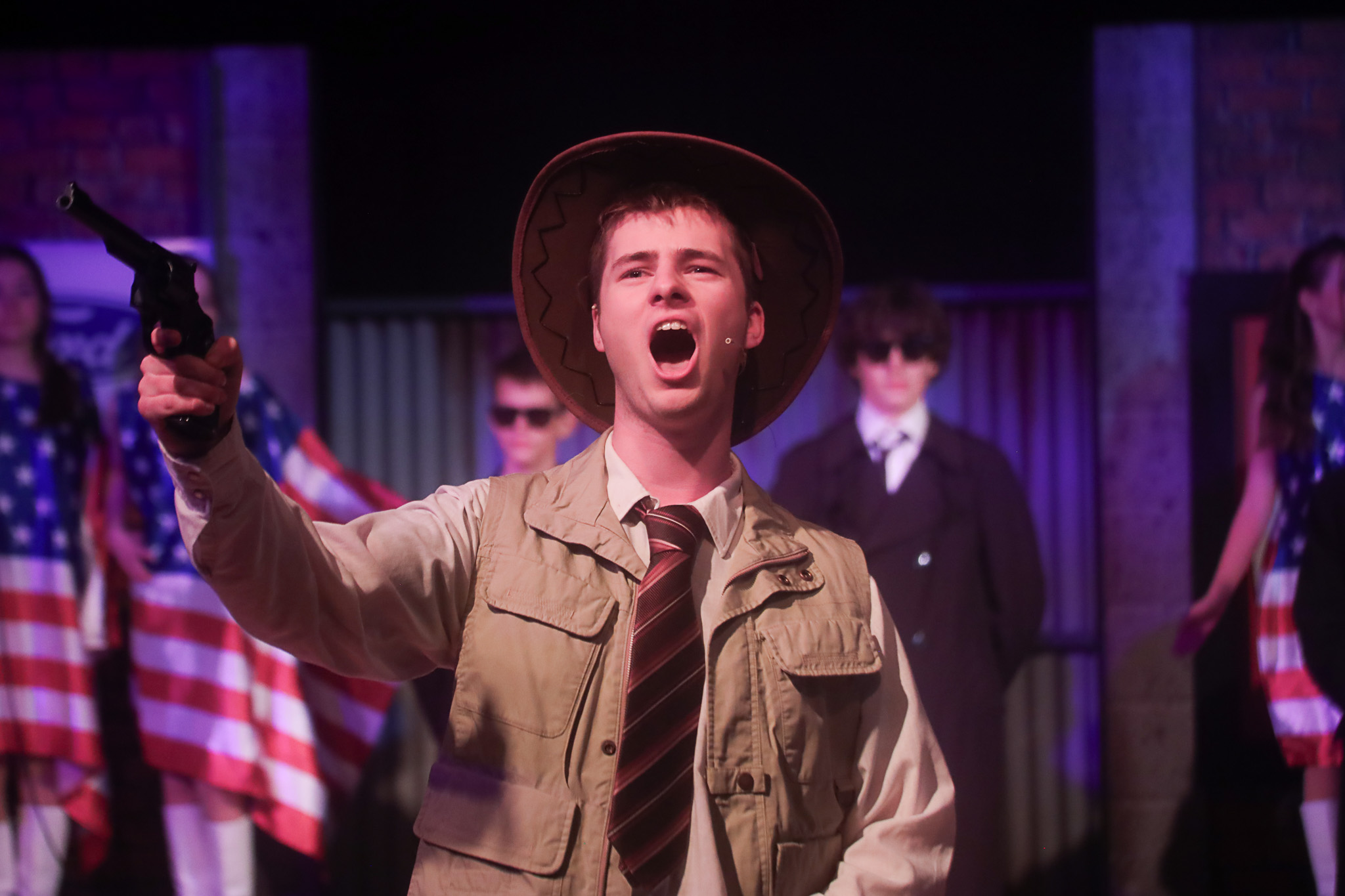
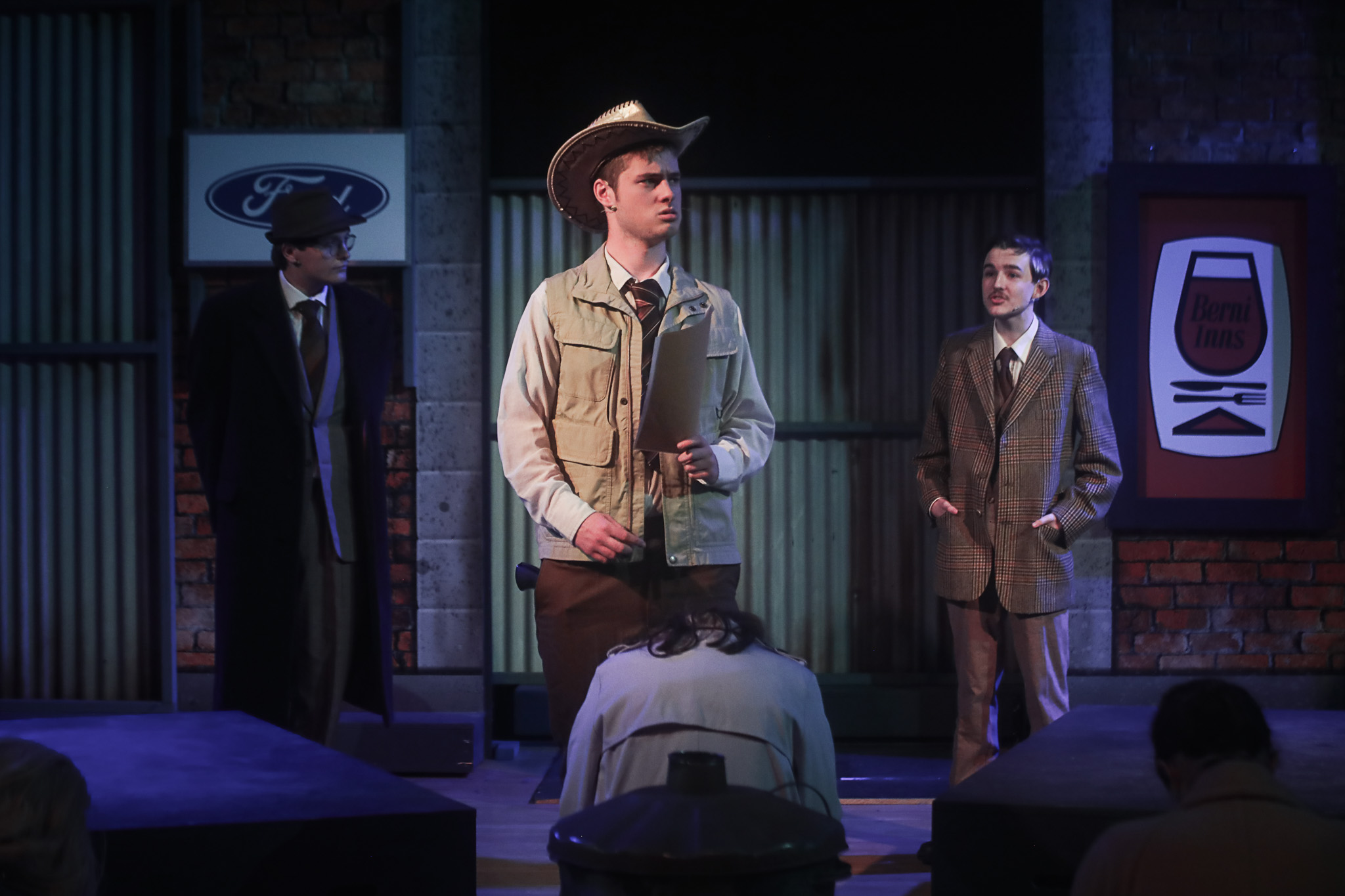
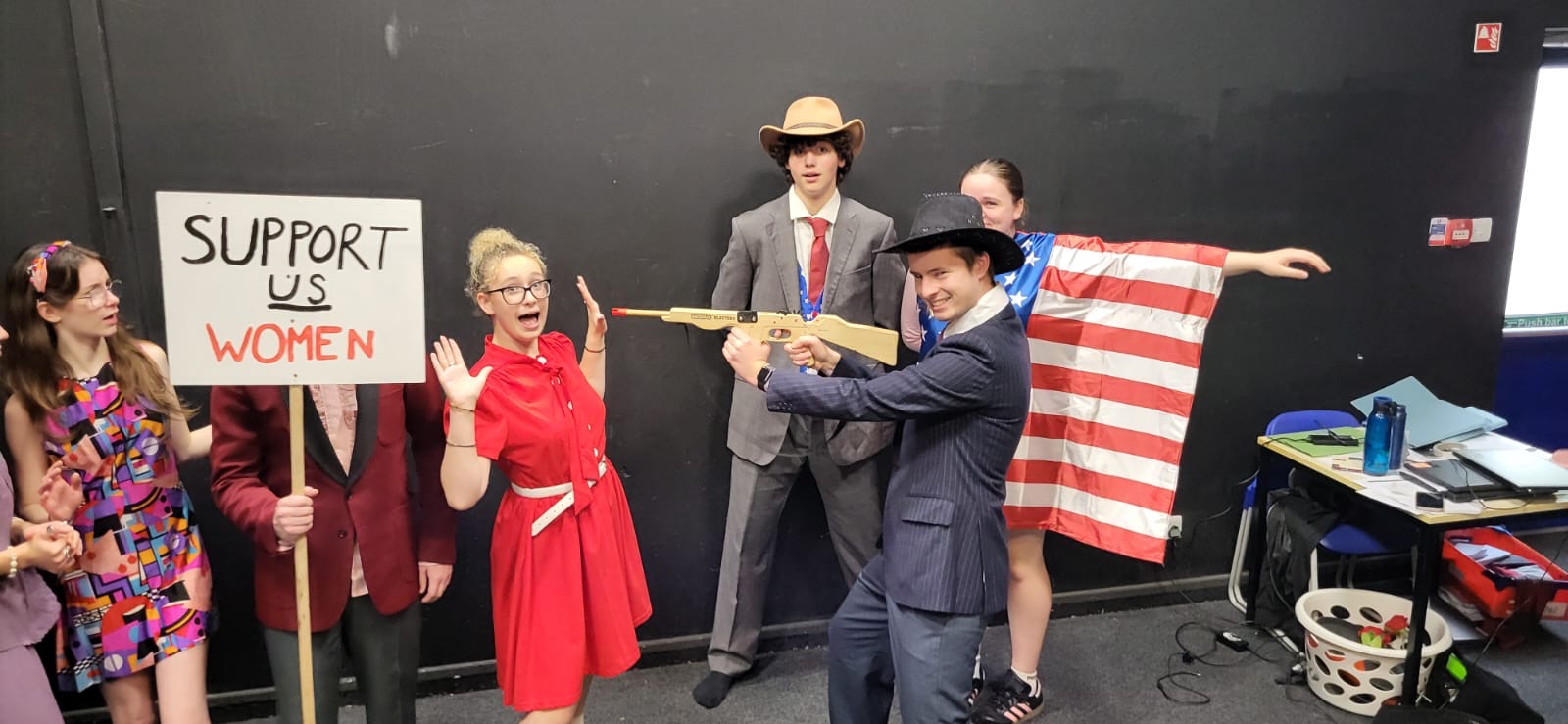
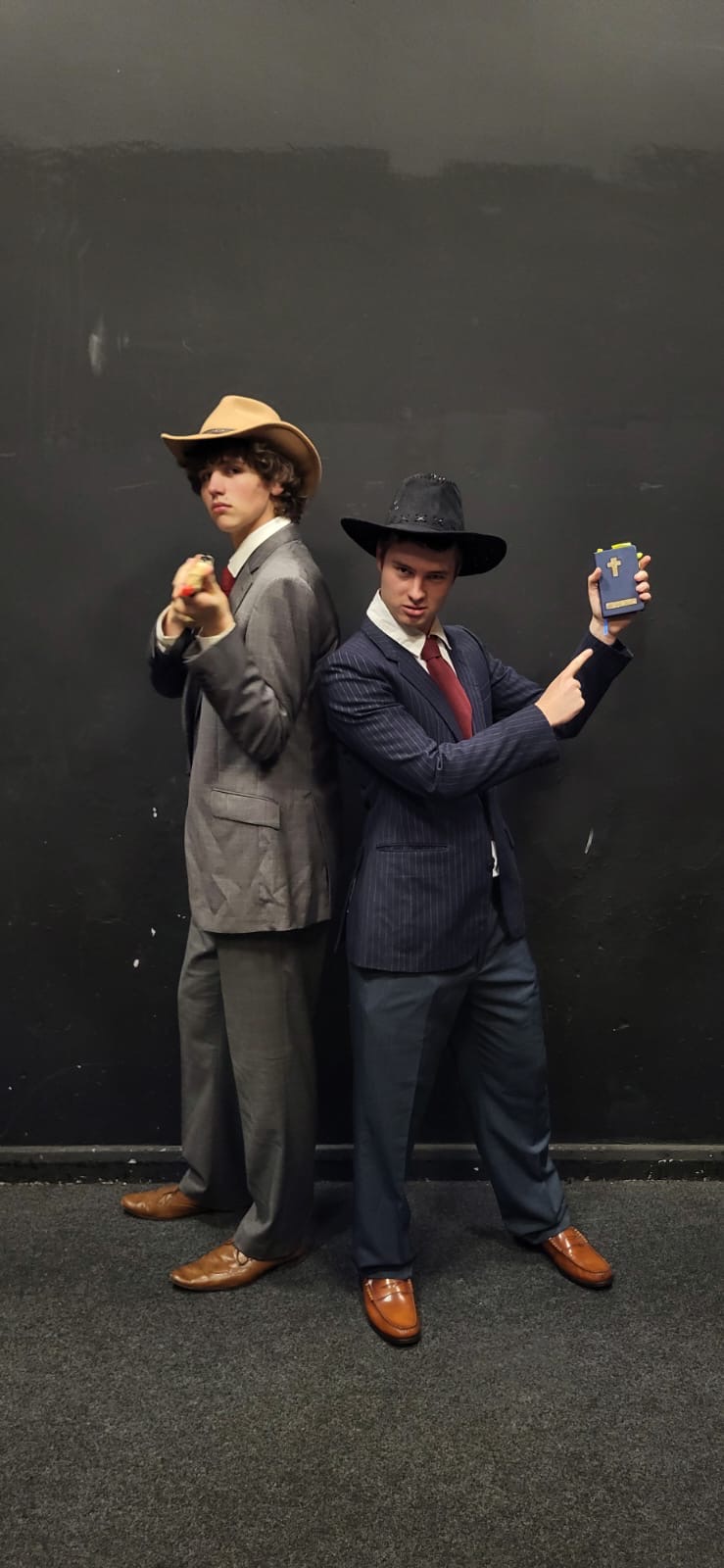
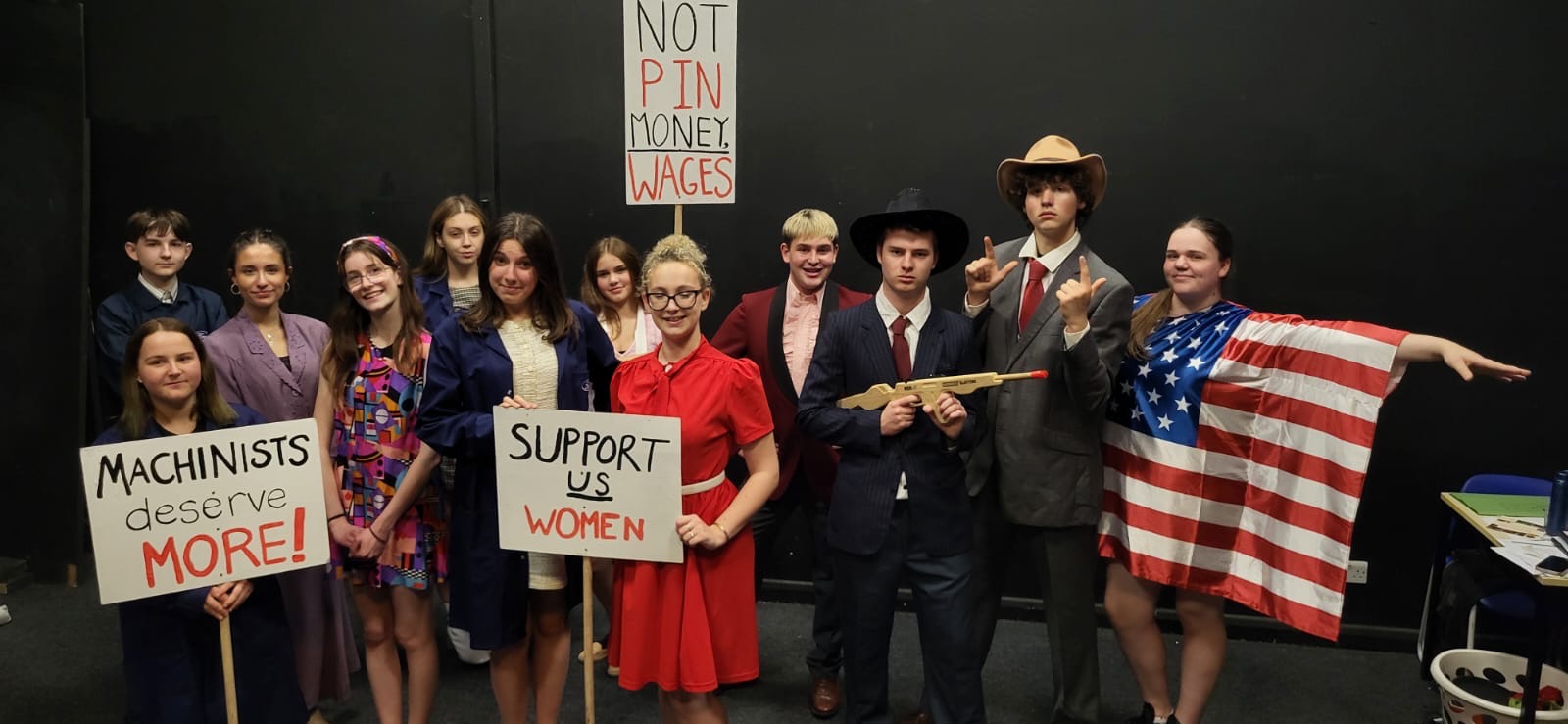
Howdy Roody Tootin dootlin doin! My name is Mr Tooley.* I'm a great American patriot which is why I'll be representing the great American nation against the Britishers in a lil musical they like to call, Made In Dagenham.
*Legal name Sam Field, but no one calls me that apart from the crooked, corrupt, border-line communist, anti-american, gun-hating exam boards.
I wrote an essay: "Evolution of the Broadway Musical"
16/03/2026
Other
This essay will analyse the development and impact of the Broadway musical through a selection of landmark productions that fundamentally altered the course of its history.
I have been officially adjudicated...
27/01/2026
Made in Dagenham
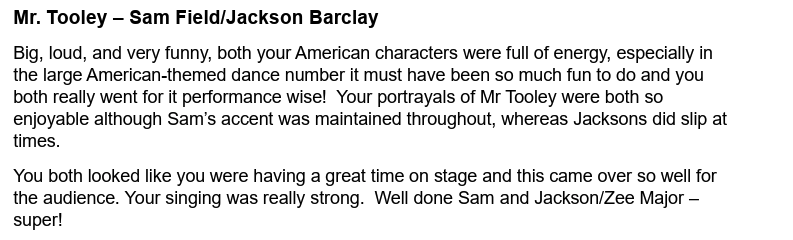
Today I received the final adjudication for my role as Mr Tooley in Made in Dagenham...
My performance of Made in Dagenham was seen by 3 different adjudicators from three different competitions. Today I received the last of the three adjudicator's reports...
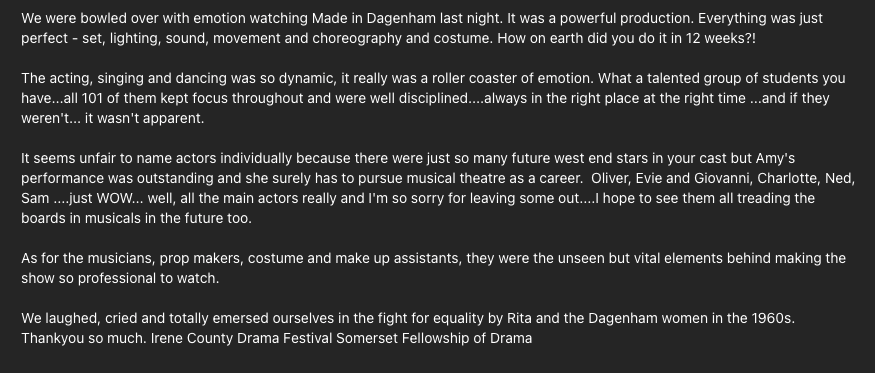
My main man, Irene, also chimed in with her own glowing words of wisdom...
Personal Feedback
I Discovered the Components of a Musical!
Lesson
19/01/2026
Other
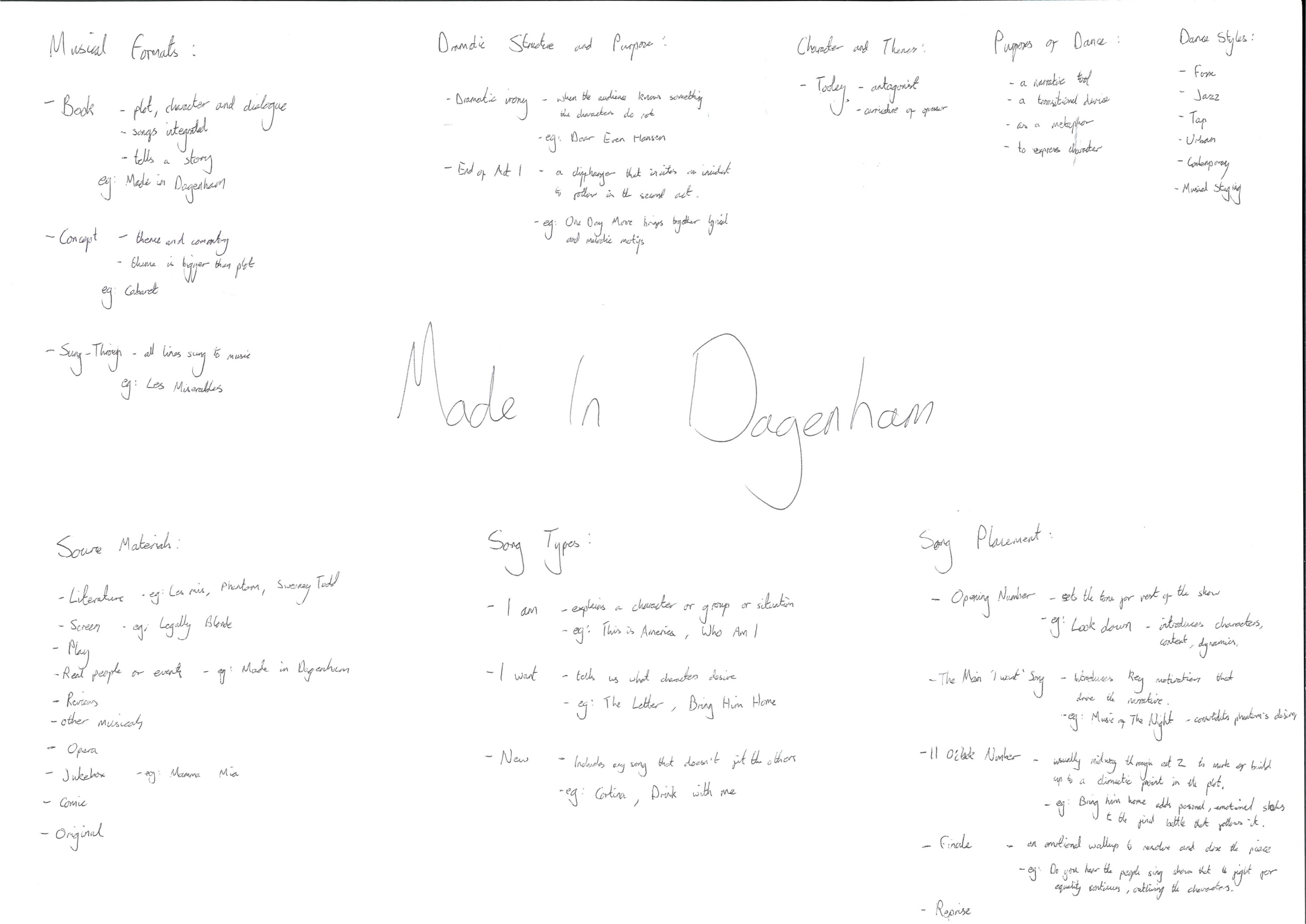
A musical doesn't just write itself, as I found out today, it is actually a carefully constructed piece of art...
In today's lesson, we were exposed to the various components of a musical, and how they all work together to create a cohesive and engaging theatrical experience:
Reflections on Made in Dagenham
28/12/2025
Made in Dagenham
This year, I had the privilege of playing Mr Tooley in my school’s production of Made in Dagenham...
When Made in Dagenham was first announced as our school musical for this year, I was intrigued. Unlike some of the grand, operatic classics I love (Les Miserables, Sweeney Todd, Phantom of the Opera), this show is rooted in realism and politics. It’s about ordinary people taking on an extraordinary system, and right at the centre of that system sits Tooley, the loud, arrogant, unapologetic face of corporate greed. Naturally, I wanted him.
From the very beginning, I knew Tooley wasn’t a character to play subtly. He’s brash, domineering, chauvinistic, and completely unashamed of it. Developing him became an exercise in confidence and restraint, knowing when to go full out and when to let stillness do the work. Writing a detailed character analysis early on helped ground my performance, especially as Tooley doesn’t change or grow like the other characters. His consistency is what makes him dangerous.
Rehearsals were intense but incredibly rewarding. Blocking sessions helped me understand how power can be shown physically through space, posture, pacing, and proximity to others.
Vocally, this show marked real progress for me. One of my main targets was "to gain confidence and maintain tunefulness at the higher end of my range", and This Is America gave me the perfect opportunity to work on that. Through much practise, I learned to trust my technique rather than approach high notes with fear. By the final performance, I was singing full out, confidently, and without hesitation, which felt like a genuine achievement.
Dance was another major area of growth. At the start of the process, I was very aware that dancing was not my strongest discipline. This show pushed me to confront dance by having me dance in several numbers: Made in Dagenham, Always a Problem, Payday, Im Sorry I Love You, and Stand Up. Through much practise at home and at rehersal, I improved my memory of choreography, which allowed me to perform with much more conviction.
The performances themselves were a learning curve. My first show came with a few hiccups: an early entrance, a wrong line, and a missing prop, but staying in character and adapting in the moment taught me invaluable lessons about professionalism in live theatre. By the final performance, everything clicked. I went full out on the character, full out on the singing, and delivered what I genuinely believe was my strongest performance yet.
Looking back, Made in Dagenham pushed me outside my comfort zone in all the right ways. It forced me to confront things I would otherwise avoid: singing up high and dancing. Overcoming my fears strengthened my confidence, sharpened my musical theatre technique, and reinforced the importance of preparation, practise, adaptability, and commitment to character. Playing Mr Tooley allowed me to explore a character who is bold, unlikeable, and larger than life, for which I loved every second of it.
It’s a process I’ll remember not just for the performances, but for how much it helped me grow as a performer. And for that, I’m incredibly grateful.
I won an award!
21/12/2025
Made in Dagenham
I was in utter disbelief when I was announced the winner of a presigious award today...
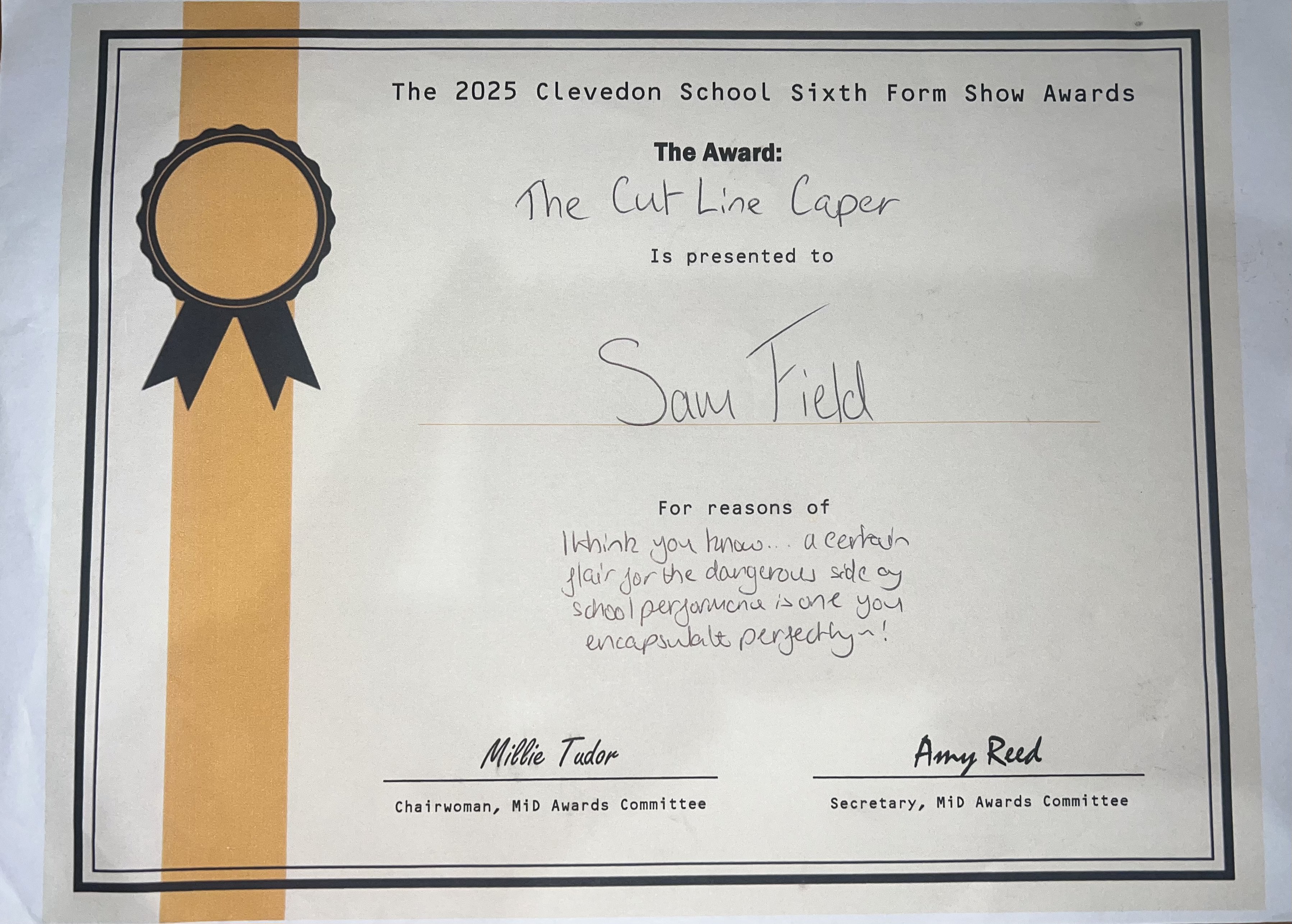
I am writing this as a very happy man. Tonight, I attended the annual Clevedon School Sixth Form Show Awards, an event of immense prestige, glamour, and absolutely no official authority whatsoever. I was completely blindsided when the evening’s distinguished presenter, Millie Tudor, announced that I had won the highly coveted award for “Cut Line Caper.”
For those unfamiliar with my work, this award recognises my brave, fearless, and frankly heroic decision to say lines in the show that had very clearly been removed from the script, in a performance so powerful, so unhinged, that it transcended the boundaries of conventional theatre. It’s nice to see that this dedication to my craft has finally been recognised.
I must extend my deepest gratitude to everyone who supported me on this journey - especially those who tried to stop me and failed. Your doubt only fuelled my performance.
The award package itself was nothing short of luxurious. I received an official certificate complete with a heartfelt handwritten message from the Secretary of the Awards Committee, the esteemed Amy Reed, as well as a genuine medal crafted from the finest gold plastic China has to offer. A true collector’s item. A family heirloom. I will certainly be passing it down through generations.
History will remember this night.
Watch Made in Dagenham
19/12/2025
Made in Dagenham
Watch the full performance of Made in Dagenham with me as Tooley.
My second favourite time of the year (second only to show week) is when the show recordings get released. From then, it is tradition that I watch my most favouritest scenes over and over again, each time with the same enthrallment as the first, as I marvel at what we created.
Everybody knows that the Friday show (closing night) was the strongest performance of the week. But unfortunately the camera was not rolling for the first part, so here I have used some editing magic to join the start of Wednesday's show with the rest of Friday's show.
The audio track switches (rather seamlessly) from Wednesday to Friday at precisely 28:50.
The video track switches from Wednesday to Friday at exactly 29:01.
Points of Interest: Click on a point below to skip to that moment in the recording.
The pressure was really on tonight, as my family were in the audience...
There’s something about knowing the people who know you best are watching that raises the stakes instantly. This wasn’t just another performance - it was my final opportunity to play Mr Tooley, and I was determined to make it count. And to raise the stakes even further - this was my last ever performance with school, as I will be heain off to university at the end of the year.
I approached this performance determined to make it my strongest performance yet. I went completely full out on the character and didn’t hold anything back. I ensred every entrance felt deliberate, every line was delivered with confidence, and Tooley’s arrogance and dominance felt sharper and more dangerous than ever.
Vocally, this performance felt especially freeing. Knowing it was the last show meant I had no need to conserve my voice, so I fully commited to the singing. In This Is America, I allowed myself to really push the sound, trusting my technique and leaning into the power of the song. My support felt solid, and I was confident in the higher parts of my range, which made the performance feel thrilling rather than cautious.
One choice I made that I’m particularly proud of was reintroducing lines in This Is America that had been cut earlier in the process. I felt that these lines added to Tooley’s characterisation and reinforced his arrogance and self-importance. Making that decision felt risky, but it paid off - the added material strengthened my performance and made Tooley feel even more larger-than-life.
Unlike my first performance, there were zero mistakes. No early entrances, no incorrect lines, and no missing props. That sese of control allowed me to stay completely present in the moment rather than worrying about what might go wrong.
I was genuinely proud of my performance today and felt that all aspects: my acting, singing, and even dancing felt as strong as they possibly could be. Dance, which started is my weakest area, felt confident and intentional. My movement supported the character rather than distracting from it, which showed how much progress I’ve made since my baseline assessment.
From a musical theatre perspective, this performance demonstrated the importance of commitment to character. Technique, rehearsal, and preparation are all imprtant, but it’s the willingness to go all in that truly elevates a performance. Tonight, I trusted my preparation and allowed myself to perform without hesitation.
My First Performance As Tooley
10/12/2025
Made in Dagenham
Tonight, I got to unleash Tooley on the world...
Tonight was my first performance as Mr Tooley, and it was intense, exhilrating, and slightly terrifying all at once. No matter how many rehearsals and tech runs you do, nothing quite compares to the moment the lights go up and you realise there is no pause button anymore.
Overall, I felt that the performance went well, especially in terms of my characterisation. From the moment Tooley entered the stage, I felt grounded in his arrogance, confidence, and sense of entitlement. Maintaining that character throughout the show was something I was partcularly proud of, as Tooley’s presence relies on consistency as he needs to feel dominant every time he appears, not just in his big moments.
That said, the performance wasn’t flawless. I made a couple of mistakes, including coming on slightly early at one point and saying the wrong line in another moment. However, I was able to recover quickly by staying in character and continuing confidently, rather than letting the errors disrupt the flow of the scene. This reinforced how important it is in musical theatre to keep going no matter what - the audience rarely notices mistakes unless you draw attention to them.
The biggest challenge came during the scene involving Rita’s speech, which is meant to be left on stage as a prop. On this occasion, the speech wasn’t there. Instead of panicking, I had to improvise in the moment while remaining completely in character. I stayed calm, adapted my physicality and reactions, and ensured that Tooley still appeared in control of the situation. This moment really tested my ability to think on my feet, and it showed me how vital improvisation skills are in live performance.
What went particularly well was my commitment to character. Even when things didn’t go exactly as planned, Tooley’s arrogance and authority remained intact. I used physicality, vocal delivery, and presence to ensure he stayed believable and threatening, which helped carry the scenes despite the hiccups.
In terms of improvement, I know I need to sharpen my cue awareness to avoid early entrances and ensure complete accuracy with lines. I also want to refine moments of stillness and pacing, especially in scenes where Tooley exerts power through control rather than volume. These are details I can now focus on with much greater clarity having experienced the show in front of an audience.
From a musical theatre perspective, this performance reinforced the reality that live theatre is unpredictable. Props go missing, lines get mixed up, and entrances don’t always land perfectly, but professionalism comes from how you handle those moments. Staying present, in character, and adaptable is just as important as technical accuracy.
Overall, my first performance as Tooley was a strong starting point. While there are clear areas to improve, particularly for my final performance on Friday, I’m confident that I can take what I’ve learned from tonight and deliver an even stronger, more controlled, and more assured performance next time.
Tech Run!
Rehearsal
05/12/2025
Made in Dagenham
My annual winter cold has returned... and just in time for Tech Run...
Today was our tech run, which meant running the show with everything in place: full costume, makeup, microphones, live band, lighting, sound effects, props, and set. It was the first time the show truly felt like a finished product, and it completely changed the energy in the room.
We worked through each number in show order, stopping when needed to fix technical issues, but largely experiencing how all the elements come together. I was involved in a large portion of the show, taking part in Made in Dagenham, Union Song, Always a Problem, Pay Day, I’m Sorry, I Love You, School Song, Everybody Out, This Is America, Storm Clouds, and Stand Up, which made the day both incredibly intense and incredibly useful.
The live band gave the music more drive, and the lighting helped shape the mood and focus of each moment. I had to be much more aware of spacing and sightlines, as costumes and set pieces changed how freely we could move compared to the rehearsal room.
One of the most significant moments for me was running “This Is America”, my solo, for the first time in the performance space with backing dancers. Having the dancers behind me completely changed the dynamic of the number. I had to be quite precise with my blocking and positioning so that I remained the focal point while still allowing the choreography to support the song. The band were also playing at a higher tempo than what I had practised, which meant some of my high notes were less supported and weak, especially as I was moving about the stage at the same time, highlighting the need for me to focus more on breath control and technique. This directly links to my singing target of maintaining tunefulness in the upper register.
Watch Me Run “This is America” for the first time
What went well during the tech run was my ability to stay focused and adaptable. I responded to technical notes, adjusted to costume restrictions, and maintained character throughout. What didn’t go perfectly was managing fatigue - by the later numbers, I could feel the physical and vocal demands building, especially as I was suffering from a cold.
To improve before the final performances, I need to rewatch the recording of my solo, so that I can identify areas where I can refine my performance. Watching the recording also made me aware of how I should improve my costume - I need to make sure my trousers are fully done up, wear a belt and acquire a holster for my gun.
From a musical theatre perspective, the tech run demonstrated how essential collaboration is. The performance relies on technicians, musicians, and performers working together. Seeing all those elements align reinforced how professional musical theatre operates and how much responsibility each performer has to support the whole production.
Doing some blocking...
Rehearsal
28/11/2025
Made in Dagenham
Acting
At today's rehearsal I blocked not one, but two of my scenes as Tooley.
Today’s rehearsal focused on blocking, which meant getting the scenes on their feet and making clear, intentional choices about how the story is told through movement and positioning on stage. We worked on two scenes involving Mr Tooley, both of which are crucial in establishing him as a dominant and threatening presence within the plot.
The first scene we blocked was the intro to “This Is America”, which is Tooley’s solo number. We decided that Tooley would enter from upstage centre, immediately placing him in a position of authority. As I entered, I struck a strong power pose upstage centre while delivering my lines loudly and with some condescention toward the British Ford managers. This instantly set up the power dynamic in the scene, with Tooley physically and vocally domnating the space.
We ran this section several times, and with each run, I refined the blocking by thinking more deeply about character motivation. Rather than simply standing in a powerful position, I started to consider why Tooley behaves the way he does in this moment. He isn’t merely introducing himself, but also asserting control, making it clear that he is the most important person in the room and that everyone else exists to serve Ford’s interests. I felt that I would be more able to communicate that intention more clearly to the audience if I should exaggerate my posture and using expansive body language.
The second scene we blocked took place immediately after “This Is America.” In this scene, Tooley questions the British Ford management about the strike and discovers that both Rita and her husband rely on Ford for their income. This revelation shifts the tone of the scene. Tooley becomes visibly angry, because he sees a missed opportunity to apply pressure from the brits, reinforcing his belief that this management is incompatent.
Like before, we developed this scene through multiple takes. Each time, I focused more precisely on Tooley’s intentions and how to physicalise them. I made the choice to use big, bold gestures when expressing anger and frustration, reinforcing his larger-than-life personality. I also decided to walk slowly and deliberately around the stage, using stillness and controlled movement to assert dominance over the other characters. This contrasted with the more frantic energy of the British managers and helped reinforce the power imbalance between them.
What went well in this rehearsal was the clarity of character that emerged as we repeated the scenes. Each run allowed me to strip away unnecessary movement and add focus on actions that clearly communicated Tooley’s authority and cruelty. The blocking choices supported the narrative, making Tooley’s threat feel calculated rather than impulsive.
One area to improve is ensuring that my physicality remains purposeful and not overly exaggerated. While Tooley is flamboyant, every movement still needs to be motivated by intention rather than habit. In future rehearsals, I want to continue refining my movement so that it feels controlled and deliberate, especially in moments of stillness.
From a musical theatre perspective, this rehearsal highlighted how blocking is an essential aspect of storytelling. In shows like Made in Dagenham, where the conflict is rooted in power and inequality, spatial relationships on stage are vital. My positioning and movement of Tooley help visually reinforce the themes of dominance, intimidation, and corporate control.
I hit on Rita
Lesson
13/11/2025
Made in Dagenham
Acting
In today's acting lesson we blocked a scene that needed a considerate approach...
In today's acting lesson, we blocked a scene near the end of the show, set in the back rooms of the TUC just before the vote on the equal pay amendment. This is a pivotal moment in Made in Dagenham, as the tension is at its highest and Tooley makes one last, calculated attempt to stop the strike through manipulation.
The scene began with Tooley entering from upstage left, where he remained partially hidden as Rita and Lisa entered and began discussing Rita’s upcoming speech. Crucially, they were unaware that Tooley was watching them. This blocking choice immediately created dramatic irony: the audience knows Tooley is there, listening and observing, while Rita and Lisa speak openly. This blocking choice built a strong sense of tension, as the audience could sense the danger long before the characters could.
From a character perspective, this moment reinforced Tooley’s predatory nature. He doesn’t rush in or interrupt, but he watches, calculates, and waits. We showed this by keeping Tooley upstage and still, this blocking also meant taht I was able to show that Tooley is always thinking several steps ahead, looking for weakness he can exploit. His motivation here is simple but chilling: if he can’t break the strike through power, he’ll try manipulation.
As Rita and Lisa briefly exited to get changed, Tooley entered the space properly and discovered Rita’s speech left on a chair. I picked it up and read it, laughing to myself. This moment was played with smug amusement, because Tooley sees the speech not as a moral argument, but as something ridiculous and disposable. I made sure the laughter felt cruel rather than comic, reinforcing that he enjoys undermining others. I then replaced the speech just before Rita re-entered, keeping the tension alive.
When Rita returned, I made a deliberate vocal choice to speak in a deep, husky, seductive tone. This was a conscious shift from Tooley’s usual bombastic delivery. In this scene, his intention is not to intimidate outright, but to unsettle and control through false charm and misogyny. I used slower pacing and quieter delivery to make the moment feel uncomfortable rather than overtly aggressive.
At one point, Tooley backs Rita into a corner while teasing her with suggestive language. Blocking this physically showed the imbalance of power - Rita is literally and figuratively trapped. When she attempts to escape, Tooley grabs her, only for her to pull away successfully. This moment was important to play truthfully, as it highlights Rita’s strength and refusal to be intimidated, while also exposing Tooley’s desperation.
The scene ended with Tooley ripping up Rita’s speech and laughing as he exited, pleased with himself and convinced he has won. From his perspective, this action is logical: if Rita has no speech, she has no voice. His motivation is to silence her, just as Ford has attempted to silence the women throughout the show.
What went well in this lesson was the clarity of intention behind each blocking choice. Every movement was motivated by character. What I need to continue working on is maintaining control so that the scene remains tense and unsettling without tipping into melodrama.
From a musical theatre practice perspective, this scene demonstrates how blocking can be just as powerful as dialogue or song. Musical theatre isn’t only about big numbers; it’s also about quiet, uncomfortable moments that push the story forward. Using space, levels, and proximity allowed the audience to fully understand the stakes without anything needing to be sung or exaggerated.
My Dancing Baseline Feedback is in...
28/10/2025
Dance
The expert has deliberated and the verdict is in...
Receiving my dance feedback felt almost as terrifying as the baseline assessment itself. But, opening the document and seeing that I had achieved a Merit left me pleasently surprised.
View my feedback below:
The feedback described me as “open minded” and willing to “give everything a go”, which is what people say when your crap at dancing but need something positive to say. (I am of course joking). That being said, open-mindedness and enthusiasm, in dance, especially when you don’t feel like it’s your strongest discipline, it can be tempting to hold back. Knowing that my willingness to fully commit was recognised reassured me that my attitude is supporting my development rather than limiting it.
It was also noted that I am “developing coordination well” and “building a sound technique in dance.” This felt particularly positive, as technique is something I’ve been consciously trying to focus on. During lessons, I’ve been making a real effort to apply corrections relating to posture, control, and clarity of movement rather than just getting through the choreography. The comment that I “takes feedback and actions it” suggests that this effort is paying off.
However, the feedback also highlighted a clear area for improvement: developing fluidity in movement and coordination to achieve a cleaner performance. This made a lot of sense when I reflected on my baseline assessment. At times, my movement can look stiff, particularly when I’m concentrating hard on remembering the choreography. When that happens, my transitions between movements become less smooth, which affects the overall quality of the performance.
What this feedback helped me realise is that my main barrier in dance isn’t effort - it’s confidence and flow. When I overthink each step, my body doesn’t move naturally, and the performance can look hesitant. This links directly to my dance target, which is to improve my memory of choreography so that I can execute dance moves with conviction and confidence. If I feel more secure in what I’m doing, my movement will naturally become more fluid and coordinated.
To improve, I plan to focus on repetition and embedding choreography into muscle memory so that I’m not constantly second-guessing myself. I also want to practise linking movements together more smoothly, rather than treating each step as a separate action. Filming rehearsals and marking choreography outside of lessons will help me identify where transitions feel awkward and where I can relax into the movement more.
From a musical theatre perspective, this feedback is particularly relevant. In ensemble-based numbers like Made in Dagenham, dance is about unity, energy, and storytelling rather than technical perfection. Characters express themselves through movement, and fluidity is essential for making choreography look confident and intentional. As I'm playing Mr Tooley, a character defined by dominance and bravado, developing physical confidence will be crucial in ensuring my performance feels grounded and authoritative.
Overall, this feedback has given me a clear sense of where I am now and where I need to go next. What went well was my commitment, openness, and ability to respond to feedback. What needs improvement is my fluidity and coordination, which will come with confidence and consistent practice. While dance may not be my comfort zone, this feedback shows that I’m moving in the right direction.
I Recieved My Baseline Singing Feedback...
24/10/2025
Singing
I was very nervous as I impatiently waited for that word document to load...
Why was I impatient? Because this very document contained one very important piece of information: my baseline singing feedback... When it finally opened, I was relieved (and slightly shocked) to see that I had achieved a Distinction for my baseline singing assessment.
For my baseline, I performed “Javert’s Suicide” from Les Miserables. I chose this song because it demands a wide range of musical theatre skills: dramatic storytelling, emotional commitment, vocal control, and the ability to shift between different vocal colours. Rather than pitch-perfect singing, this song is more about embodying a character at their breaking point, which makes it a perfect piece to assess both vocal and acting technique.
View my feedback below:
The written feedback described my performance as a “connected and passionate version of Javert’s Suicide,” highlighting my use of declamatory singing, open throat, and well-supported high notes. Reading that was hugely encouraging, as it confirmed that I was on the right track with my target of improving my singing up high.
What pleased me to see the most was the recognition of my connection to the character. Javert is a role that relies heavily on internal conflict, and knowing that my performance came across as passionate reassured me that my acting choices were effective and truthful. The mention of declamatory singing also suggested that I was successfully using speech-like vocal delivery where appropriate, which is essential in sung-through musicals like Les Miserables.
However, the feedback didn’t just praise, it also challenged me, which is exactly what I wanted as after all, this is how I'll improve. I was encouraged to “keep playing with the dynamics of the song” and to explore “how small can you make the quiet notes while still being heard.” I was also asked whether I could find even more light and shade in the upper register. This really made me think. While my high notes were described as well supported, I realised that I often approach the upper end of my range with a mindset of “just get through it.” That can sometimes lead to playing it safe dynamically. In a song like Javert’s Suicide, that is most definately a missed opportunity - the emotional tension comes from contrast, not just volume.
To improve, I plan to experiment more with dynamic control, particularly in quieter moments. I want to explore how little sound I can use while still maintaining clarity and support, rather than defaulting to a stronger volume for security. This will involve practising sustained phrases and trusting my breath support instead of pushing.
This directly links to my singing target: to gain confidence in and maintain tunefulness at the higher end of my range. When I work on showing more light and shade in the upper register, I’ll not only improve my expressive range but also develop confidence in controlling my voice rather than letting nerves take over.
From a wider musical theatre perspective, this process reflects how performers must constantly balance technical precision with emotional truth. In shows like Les Miserables (and also Made in Dagenham!) characters live or die by their emotional honesty. Singing loudly isn’t the same as singing powerfully; sometimes restraint can be far more effective.
Overall, this baseline gave me a strong starting point. What went well was my character connection, vocal support, and commitment to the piece. What didn’t go perfectly, and what I need to work on, is dynamic risk-taking, especially in the higher register. Moving forward, I want to be braver with my choices and trust that technical control will support expressive freedom.
I Played Dress-Up
Lesson
23/10/2025
Made in Dagenham
In today's acting lesson, we selected outfits for our characters...
Possibly my favourite part of musical theatre is experiencing the feel of extravagant costumes. There’s something so magical about slipping into an outfit and instantly feeling your character come to life - the posture changes, the walk changes, even your expression changes. Today’s lesson was all about that transformation.
We were tasked with rummaging through the drama department’s legendary costume cupboard (a treasure trove that’s basically a land-fill site for costumes) to find outfits for our characters in preparation for a photoshoot. These photos will be used to promote our musical on social media and in local newspapers, so the pressure was on to make sure each costume captured our character’s essence.
Choosing Mr Tooley’s Look
When it came to choosing an outfit for my character, Mr Tooley, I had to consider not just what he might wear, but what his clothes say about him. Tooley isn’t just any businessman, he’s an American Ford executive, the very image of corporate arrogance and power. His costume needed to scream authority, confidence, and just a touch of absurd excess.
I decided on a sharp, tailored suit - the classic armour of the capitalist elite. It’s clean, crisp, and completely devoid of personality, which in a strange way makes it perfect for Tooley. The suit acts almost like a uniform of superiority: he doesn’t need flamboyant colour to make a statement; the authority comes from the cut and the confidence with which it’s worn.
To add a bit of character flair, I chose a red tie, which felt like the perfect accent. Red is the colour of power, aggression, and dominance - all qualities that Tooley exudes in abundance. It also adds a visual pop that makes him stand out against the more muted tones of the factory workers’ costumes, reinforcing that he’s from a different world entirely.
Then, I topped it off with a cowboy hat. This small addition injected just the right amount of American flamboyance - it’s bold, brash, and unapologetically “USA.” It transforms Tooley from a generic executive into a walking caricature of American capitalism: loud, proud, and slightly ridiculous.
Finally, I found a couple of props that really helped round out the image - a gun and a Bible. Both are stereotypical American symbols of power and morality (or, in Tooley’s case, self-righteousness). Together, they perfectly encapsulate the irony of his character: a man who preaches values and progress while embodying greed and control.
Reflections and Analysis
What struck me most today was how much a costume can do for characterisation. As soon as I put on the suit and tie, I stood taller. My shoulders squared, my jaw set, and my voice naturally dropped twenty octaves - I instantly felt Tooley’s energy taking over. I found it incredible how physical transformation can inform internal performance.
The cowboy hat added an element of fun that made me think more deeply about how Tooley might see himself - a larger-than-life hero of industry, galloping in from across the Atlantic to “save” the day. That overconfidence and theatrical self-belief are essential to his character, and wearing the costume helped me access those traits instinctively.
What Went Well / What I’d Improve
I was really happy with the choices I made for Tooley’s outfit - I think they communicate his personality instantly, even without context. The combination of the suit, red tie, and hat manages to balance humour with menace, which is exactly what I want to achieve in performance.
If I could improve anything, I’d spend more time experimenting with how Tooley wears the costume - how he buttons his jacket, adjusts his tie, or tips his hat. These small details could really bring his arrogance and showmanship to life in the photoshoot.
Links to Musical Theatre Practice
Costume plays a vital role in musical theatre because it helps bridge the gap between reality and heightened performance. For Made in Dagenham, the contrast between the workers’ practical clothes and Tooley’s pristine suit visually tells the story of power and inequality before a word is even sung.
It also reminds me that costume can be used for comedy. Tooley’s outfit walks a fine line between intimidation and parody, much like many comedic antagonists in musical theatre. It’s that blend of truth and exaggeration that makes the performance entertaining.
I Was Assessed On My Singing
Baseline Assessment
24/09/2025
Singing
To assess my current singing ability, I was subjected to a baseline singing assessment today...
Today's singing lesson started off with us looking at something called the larynx, or in my English: the voice box. The larynx is a small but incredibly important structure located in the throat, just above the windpipe. It houses the vocal cords, which vibrate to produce sound when air passes through them. It's the larynx that allows us to speak, sing, and make all noises. By learning about the larynx, we gained insight into how sound is physically created in the body and how various factors, like tension, can affect our voice's tone, pitch, and quality.
After exploring the larynx, we took a look at vocal registers. Vocal registers refer to the different ranges of the voice. The primary registers we discussed include the vocal fry, chest voice, head voice, and falsetto. Vocal Fry is the lowest vocal register. The chest voice is the deep, rich sound that resonates more in the chest area, often used for speaking or lower singing notes. The head voice is a lighter, more resonant sound that vibrates higher up in the head, typically used for higher pitches. Falsetto, on the other hand, is a breathier, airier sound that’s often associated with a very high range. It is important for a performer to understand these registers, as they can help them control their voice and achieve the desired tone, pitch and vocal effect for their performance.
After learning about the larynx and vocal registers, I was subjected to a singing assessment. We were tasked with singing any musical theatre song. I chose to sing 'Javert's Suicide' from the greatest musical of all time, Les Miserables. I chose to sing this song as it fits my voice type as a dramatic bass and because it allows me to demonstrate several vocal techniques (belt, legato & declamatory singing, vibratto, dynamics, sustained notes, and emotional acting through voice) which seemed appropriate for a unit titles 'Musical Theatre Techniques'. As Javert is a baritone, and I am a bass, I performed the song in a much lower key than the original (down 7 semitones).
Watch: My Baseline Singing Assessment
Reflections
Overall, I was fairly pleased with my baseline singing assessment, as I was able to demonstrate a range of vocal techniques and perform the song in a way that suited my voice type. My tone was mostly controlled, and I felt that I conveyed the general style of the piece with awareness of musical theatre performance values. However, there were also areas for development, particularly in my handling of higher belt notes and in my preparation for the assessment.
One of the main issues was my approach to the first belt. I attempted to sustain the vowel sound in the word “reprieved” as “re-PREE-ved,” which caused unnecessary tension in my throat and led to a slight strain. A more effective choice would have been to modify the vowel to “re-PRAY-ved,” which would have allowed greater freedom in resonance, enabling me to place the sound more comfortably. In musical theatre, vowel modification is an essential technique for belting, as it allows performers to sustain powerful notes without damaging their vocal health. If I adjust this, I could achieve a more rounded, resonant sound while maintaining the expressive quality of the performance.
The second belt was also challenging, as I failed to reach the correct pitch. The difficulty lies in the fact that the final note is written as a B natural, which is outside the key of F major (which contains B flat). Because of this, the interval feels unusual, and without recent rehearsal, I struggled to pitch it accurately. If I had spent more time practising the song beforehand, I could have internalised the note through muscle memory and pitch recognition. This links to the discipline of musical theatre training, where consistent rehearsal and repetition are key to overcoming technical challenges and ensuring vocal accuracy in performance.
Another factor that limited my performance was a lack of preparation and physical readiness. I did not warm up before singing, which undoubtedly made hitting the higher notes more difficult, and I was also recovering from COVID, which affected my breath support, vocal stamina and caused me to have a sore throat. Warming up is a fundamental aspect of vocal health for musical theatre performers, as it prepares the voice for the physical demands of singing, protects against strain, and enhances flexibility across registers. Had I incorporated a structured warm up, I would likely have achieved greater ease in the higher sections and a more consistent tone overall.
Despite these challenges, I am pleased with certain elements of my performance. I demonstrated control in the lower register and showed an awareness of stylistic choices that are relevant to the musical theatre genre. Going forward, I aim to work on consistent warm ups, vowel modification for belting, and rehearsal strategies that help me memorise and pitch difficult notes with accuracy. These skills are not only important for improving my singing technique but are also directly relevant to performing in musical theatre, where vocal stamina, accuracy, and expression are all vital to communicating character and story effectively.
I'm In Another Dance!
Rehearsal
19/09/2025
Made in Dagenham
Will it ever end? At today's rehearsal, I found out that my dancing skills are required yet again...
For a musical all about women’s rights, there are quite a few epic all-male numbers - and today’s rehearsal was proof of that. The testosterone levels were through the roof, and the decibel level wasn’t far behind.
This rehearsal was split into two parts: first, we worked on singing the rousing anthem "Made in Dagenham", and then we moved to the hall to learn the accompanying choreography. The masculine energy todya was electric...
Part One: Singing "Made in Dagenham"
We started by learning the harmonies and rhythms of the song, which celebrates the pride and power of the Ford factory workers. Even though it’s sung by the men, it sets the tone for the entire show - full of drive, unity, and working-class determination.
I really enjoyed the singing section, partly because it’s one of those songs that makes you feel like you’re part of something huge. The melody is bold and rhythmic, and when everyone sings together, it creates this wall of sound that feels genuinely powerful.
From a technical point of view, I paid attention to breath control, since the song is energetic and demands strong projection.
It helped that the vocal director kept reminding us to sing through the phrase, not to punch every note, but to carry the energy forward.
Part Two: Choreography
After conquering the vocals, we moved to the school hall to learn the choreography for the same number. This is where things got interesting.
The movement for "Made in Dagenham" is bold, masculine, and full of purpose. It’s powerful without being overly complicated, relying on strong, confident gestures and unison work to create impact.
That said, the choreography looked simple until we actually started doing it. Keeping the energy high while staying in time was a bit of a workout.
As part of the ensemble of factory workers, I had to focus on staying synchronised with the group while still performing with intention - not just doing the moves, but living them. The key was to find that balance between discipline and swagger. After all, these men aren’t professional dancers; they’re factory workers expressing pride and solidarity.
Reflections and Analysis
What struck me most today was how much character comes through in movement. The choreography was about embodying the rough, grounded energy of the men. When we all hit the beat together, stomping in rhythm, it genuinely felt like we were part of something powerful.
I also realised that dancing with purpose makes a huge difference. Once I stopped worrying about whether I looked awkward and started focusing on why the characters were dancing, to show unity and strength, everything felt more natural.
What Went Well / What Didn’t
What went well:
I stayed vocally strong during the singing rehearsal.
My confidence in the choreography grew quickly. I picked up the moves faster than I expected.
I felt more connected to the group energy, which helped keep me in time and focused.
What didn’t go so well:
I need to project more confidence in my movements. Some parts still feel tentative, especially when the tempo picks up.
How I Will Improve
To improve, I’m going to rehearse the dance with the music a few times at home to build stamina and rhythm memory. I’ll also practise singing parts of the song while moving to simulate performance conditions. That way, I can strengthen my breath control and maintain pitch while dancing.
In future rehearsals, I want to focus on performing the choreography with more commitment: bigger movements, sharper energy, and less hesitation. If I can look confident, even when I’m slightly unsure, the audience will believe it.
Link to Musical Theatre Practice
Musical theatre thrives on numbers like this - ensemble pieces that bring energy, unity, and rhythm to the story. In the same way that "One Day More" drives Les Miserables, "Made in Dagenham" captures the heart of the workers’ pride and resilience.
Link to My Targets
Singing: I maintained tunefulness and confidence when singing. Dance: This rehearsal strongly supported my dance target. I worked on memory, timing, and conviction, and I’m learning how to express character through strong, grounded movement.
I Can’t Dance… But I Was Assessed on It Anyway!!!
Baseline Assessment
18/09/2025
Dance
I am NOT a dancer... I am most certainly doomed for failure...
Twas a terrifying day today when I rocked up to my dance lesson, to find out that I would be assessed on my dancing abilities! I am NOT a dancer.
Nevertheless, this lesson marked my baseline dance assessment, designed to establish my current technical ability, confidence, and performance skills in dance as part of Unit 27: Musical Theatre Techniques.
The assessment was split into three key areas designed to push my dancing abilities to thier absolute limit: a corner phrase, a centre phrase, and performing choreography with character.
The first section was a corner phrase, which involved travelling from one corner of the studio to the opposite corner while performing a complex sequence of plies, rises, and jumps, all set to a steady beat. The aim here was to demonstrate timing, coordination, and control while moving across the space. While I understood the movements themselves, I struggled at points to stay fully in time with the music. I found that once I lost the beat, it was difficult to recover quickly, which affected the clarity of the phrase.
The second section was a centre phrase, made up of an extravagent variety of swings, turns, and sophisticated arm movements. This was more challenging for me initially, as there were several movements to memorise in a short space of time. At the start, I found myslef second-guessing what came next, which made the phrase feel hesitant. However, as we repeated it multiple times, my confidence improved. Muscle memory began to kick in, and I felt much more secure by the end of the lesson, which showed me how important repetition is for my learning process.
The final part of the assessment focused on adding character to dance, using the Pay Day choreography from Made in Dagenham. As Mr Tooley does not appear in this number, I performed as an ensemble member - a local geezer enjoying payday. This was the section I felt most comfortable with. Even though my dance technique isn’t my strongest area, I was able to bring enthusiasm, character, and some level of intent to the movement. I consciously used performance energy to mask my lack of confidence in certain steps, which helped the choreography feel more alive.
That said, this section wasn’t perfect. I forgot a move at one point and felt myself stiffen during some of the choreography, particularly when I became overly aware of my technique. This highlighted a recurring issue for me: when my memory slips, my confidence drops, and my movement becomes more restrained.
Looking back, what went well was my commitment to character and my willingness to perform, even when unsure. My musicality and enthusiasm helped carry the dance, especially in the Pay Day section. What didn’t go as well was my timing in the corner phrase and my reliance on memory in the centre phrase, which sometimes affected my confidence and fluidity.
To improve, I need to focus on strengthening my choreography memory, which directly links to my dance target: to improve my memory of choreography so that I can execute dance moves with conviction and confidence. I plan to do this by breaking choreography down into smaller sections, practising transitions between movements, and rehearsing without music to ensure I fully understand the sequence before adding performance.
From a musical theatre perspective, this assessment reinforced how dance is used as a storytelling tool. In shows like Made in Dagenham, dance isn’t about perfection, it’s about energy, character, and ensmble unity. While technical accuracy is important, confidence and commitment are what truly sell a number to an audience.
Although I may not be a dancer (yet), this baseline assessment has given me a clear starting point. With focused practice, repetition, and a bit more trust in myself, I know I can improve my dance ability and perform choreography with far more confidence as the course progresses.
I'm Not Only In One Dance... But Two!
Rehearsal
18/09/2025
Made in Dagenham
I was very relaxed when I rocked up to rehearsal today… at least I was relaxed... right up until it was announced that I’d been added to another dance!!! There wasn’t even time to process the news or stage an all-out protest before I had to face the choreographers, who were all too happy to teach me my new routine.
The number in question was "Pay Day". A high-energy ensemble number set in a lively local bar, where the Ford Dagenham workers celebrate receiving their wages. It’s upbeat, joyful, and filled with laughter, and a healthy amount of chaos - pretty much everything you’d expect from a payday party… minus the actual pay.
What Happened in the Rehearsal
The rehearsal kicked off with a brief introduction to the scene’s context: the workers are letting loose after a hard week, so the choreography needed to feel relaxed, spontaneous, and full of life. Once we started learning the choreo though, I quickly discovered that "relaxed" does not mean easy.
After being paired up with my partner, we were taught the choreography section by section. The dance incorporated all sorts of moves: side steps, shimmies, and even a partner spin! For the average dancer, it might have been "fairly simple", but for me, it was more like navigating an obstacle course while trying to look like I was having a good time.
As always, the first run-through was the hardest. I found myself overthinking every move, trying to remember the steps, the timing, and the direction all at once. My partner was wonderfully patient, even when I may have accidentally spun in the wrong direction (once… or twice (ok…, literally every time!)).
After a few shaky attempts, things started to click. I began breaking the choreography down into smaller sections and, just like I mentioned in my dance SMART target, I gave names to each move to help me remember them - “The Payday Point,” and “The Spin of Doom” quickly became part of my vocabulary. Surprisingly, this seamingly stupid method worked. With each repetition, the sequence started to feel more natural.
We practised the dance several times, tightening transitions and smoothing out timing. By the end of the session, I’d remembered almost everything. Almost being the key word. While I still stumbled once or twice, I felt a lot more confident than when we began.
Reflections and Analysis
What I found most interesting about today’s rehearsal was how much fun the dance became once I stopped worrying about being perfect. When I focused less on getting every move exactly right and more on enjoying the story, letting myself flow loosly with the music, improvising when I had to, celebrating with the other workers, living in the moment - everything worked better. The energy of the song is infectious, and when the ensemble collectively hits that rhythm, it’s hard not to enjoy it.
This dance also gave me a chance to explore ensemble work in a different way. Unlike "Always a Problem", where the humour came from exaggerated formality, "Pay Day" is all about authenticity - it’s rough around the edges, spontaneous, and human. That contrast makes it a really fun number to perform.
What Went Well / What Didn’t
What went well:
I picked up the choreography faster than I expected. Using my naming technique really helped me retain each section.
My confidence grew noticeably during the rehearsal, and by the end, I was dancing more freely and committing to the movements rather than overthinking them.
My partner and I developed a good sense of rhythm together, which made the spins (eventually) smoother and less hazardous to nearby castmates.
What didn’t go so well:
Remembering the exact order of moves was a challenge at first, and especially when the music sped up.
I still need to work on keeping my energy consistent throughout the entire number. It’s easy to start strong, but maintaining that momentum through every verse and chorus is tough.
How I Will Improve
To improve, I’m going to keep using my move-naming technique, but I’ll also practise running the routine mentally - visualising each section before physically doing it. I’ve found that helps reinforce the sequence in my memory. I’m also planning to use the video recording we took at today's rehearsal of the dance so I can review my timing and spacing.
Additionally, I want to focus on my performance energy - smiling, connecting with the ensemble, and embodying the celebratory mood of the scene.
Link to Musical Theatre Practice
In musical theatre, ensemble numbers like "Pay Day" are the heartbeat of the show. They might not always feature the main characters, but they create atmosphere, energy, and community, reminding the audience what the story is really about. For Made in Dagenham, this song represents the workers’ spirit, solidarity, and joy, even in the face of inequality.
Learning this dance also made me appreciate how musical theatre choreography isn’t about technical perfection; it’s about storytelling. Every movement should reflect the characters’ emotions and relationships. In this case, the relief and celebration that come with a well-earned pay packet.
Link to My Targets
Dance: This rehearsal directly supported my dance target of improving my choreography memory and execution. I proved to myself that, with patience and the right techniques, I can pick up routines more efficiently. My next step is to refine precision and add confidence to my delivery so it looks effortless.
I Learnt How To Sing...
Lesson
17/09/2025
Singing
In today's singing lesson we looked at the fundamentals of vocal technique...
In today’s singing lesson, we focused on vocal technique and why it is such a vital foundation for singing in musical theatre. A strong technique is what allows performers to sing safely, consistently, and expressively - especially in demanding shows.
We explored several elements of vocal technique, including posture, diaphragmatic support, larynx positioning, belting, and resonance, and how each of these contributes to a healthy and effective singing voice.
One of the key areas we discussed was posture. Correct singing posture involves keeping the head level, chest lifted, shoulders relaxed and back, knees unlocked, and feet shoulder-width apart. This posture allows the lungs, diaphragm, and throat to function efficiently, maximsing airflow and reducing tension. However, we all know that musical theatre performers don’t always get the luxury of perfect posture. Songs like “Serious” in Legally Blonde require singing while leaning over a table, and Valjean’s Soliloquy in Les Miserables often has the performer kneeling. Add choreography into the mix, and it becomes oh so clear that good technique needs to be adaptable, not rigid.
We also looked closely at diaphramatic support. The diaphragm is a large muscle located beneath the lungs, and its contraction and relaxation control airflow during breathing. Engaging the diaphragm while singing allows for a louder, richer, and more resonant sound, as well as better stamina for sustained notes. Singing without this support (relying instead on shallow throat breathing) can lead to strain and reduced vocal control.
Another major focus was the position of the larynx (or in my english: the voice box). The larynx plays a crucial role in pitch and tone quality, and its position can dramatically affect vocal health. A neutral larynx position creates a free, easy sound, while a low larynx can produce a deeper, rounder tone. Conversely, a raised larynx, particularly when reaching for high notes, can lead to a squeezed, strained sound and even vocal injury. We discussed how singers can become more aware of their larynx position through exercises such as pitch glides, allowing it to move naturally rather than forcing it.
We also touched on belting, a technique frequently used in musical theatre to create powerful and emotionally charged moments. While belting can sound impressive, it must be approached with care. Good posture, diaphragmatic breathing, relaxation, and an open mouth are all essential. One key takeaway was that belting should feel easy - if it feels painful or forced, something isn’t right.
Finally, we explored resonance, which uses the body’s natural spaces to amplify sound. Different types of resonance create different vocal colours, each suited to particular styles and characters within musical theatre. Understanding this helps singers make more informed choices about how they want their voice to sound in different moments.
Reflecting on this lesson, what went well was my understanding of the technical concepts and my ability to link them to real musical theatre examples. What I need to work on is consistently applying this knowledge in my own singing, particularly when nerves come into play.
This lesson links directly to my singing target: to gain confidence in and maintain tunefulness at the higher end of my range. Focusing on elements of good technique such as diaphragmatic support, larynx stability, and resonance, will allow me to approach higher notes with more control and less fear, allowing me to sing with confidence rather than tension.
I Have To Do A Dance... Uh Oh...
Rehearsal
15/09/2025
Made in Dagenham
Mr Tooley doesn't appear until the very end of the first act, so in the beginning of Act 1, I will be in the ensemble, which means I have to dance...
Mr Tooley doesn’t appear until the very end of Act 1, so, at the start of the show, I’ll be part of the ensemble - which, this year, means one thing: I have to dance.
I've been lucky enough to have avoided too much dancing in previous shows, but, alas, all good things must come to an end. This year, my streak of avoiding choreography has officially been broken, and I find myself facing my biggest challenge yet: actual dancing...
What Happened in the Rehearsal
Today was our first rehearsal, in which we focused on learning the choreography for “Always a Problem”, sung by the ever-charismatic Harold Wilson, the Prime Minister. The song itself is a sharp, witty parody of political showmanship, which poks fun at the endless parade of problems faced by those in power and their often ridiculous attempts to seem in control. It’s fast-paced, funny, and full of energy.
In this number, I’m one of Harold Wilson’s aides - one of the background political figures tasked with nodding enthusiastically, looking terribly important, and, most importantly, keeping in time. The choreography reflects the satire of the song: light, playful, and deliberately exaggerated to the point of absurdity.
We spent the rehearsal blocking out the formations and learning the main section of the choreography. Our choreographer emphasised sharp transitions between levels and positions - it’s all about order and control, which suits the song’s theme perfectly. There’s even a little moment where the aides mirror Harold’s gestures in a way that feels almost puppet-like which was an image I thought was a clever touch.
Initially, I was uncertain about dancing. My brain doesn’t naturally process dance moves very easily and as such, my internal monologue during the first run-through was a slow something like: “Left foot? No, other left foot!” But once I got into the rhythm, I found myself actually enjoying it.
To help myself remember the chorography, I used one of the memory techniques I mentioned in my dance SMART target: naming each move. For example, a sweeping arm became “the Wilson wave,” a bob became “the Great British Bob.” I also linked certain movements to specific lyrics in the song, so each lyric acted as a little mental cue. It sounds silly, but it really helped me retain the sequence more effectively.
Character Connection
Even though this was an ensemble number, I still had a character to portray. While my main character, Tooley, doesn’t appear in this scene, I see this as a chance to establish the world he inhabits - one full of pomp, power, and performative politics. As one of the aides, I tried to move with a kind of false professionalism: a stiff upright posture, rehearsed smiles, and gestures that felt more like performance than authenticity. It worked well for the role of an aide, and was also kind of a subtle way to mirror the artificiality and arrogance that Tooley later embodies so loudly.
What Went Well / What Didn’t
I was genuinely pleased and pleasantly surprised with how quickly I picked up the choreography. Despite my initial self-skepticism, I felt that I did manage to memorise the sequence in the short time we had, which is definitely progress for me. I could also feel an improvement in my confidence - by the end, I didn’t second-guess myself as much as I might have last year.
That said, my timing still needs tightening. Occasionally, I found myself half a beat behind the others, especially during formation changes. There were also a few moments when my focus slipped - it’s one thing to get the steps right, but keeping them performative (smiling, projecting energy, staying in character) is a skill in itself.
How I Will Improve
Going forward, I will watch the video recording of the choreography we took during today's rehearsal so that I can review and practise at home. I’ll also continue using my naming-and-lyrics technique as it did seem to genuinely help me recall movements in order. I’d also like to start focusing more on intention behind each movement: what my character is thinking or feeling in each beat, rather than just executing steps mechanically.
Link to Musical Theatre Practice
This rehearsal made me realise a great truth of musical theatre: dance isn’t just about movement, it’s storytelling. Even in ensemble moments, choreography is used to communicate mood, theme, and character. In “Always a Problem,” the choreography satirises the rigid, performative nature of politics - and as an ensemble member, it’s my job to embody that through exaggerated precision and comic seriousness.
Link to My Targets
Singing: Although this rehearsal focused on the choreography, I will have to sing, along with the rest of the ensemble, whilst dancing. I will need to practice staying engaged vocally while dancing, which will help me strengthen my breath control and maintain pitch - great practice for my upcoming solo song.
Dance: I’m pleased with my early progress in remembering choreography, especially using the naming technique. My next goal is to add precision and confidence so that my movements look intentional, not cautious!
Acting:
Setting My SMART Targets
13/09/2025
Acting
Singing
Dance
I set myself some SMART targets to help me improve myself as a performer...
Initial Audit of My Skills
12/09/2025
Acting
Singing
Dance
From acting to singing and to dancing, I put my skills to the test with a highly sophisticated tick sheet...
Who Is Mr Tooley?
12/09/2025
Made in Dagenham
I will be playing Mr Tooley in my school's musical production of Made In Dagenham, so as I like to do with all of my characters, here is my character analysis of Tooley...
Mr Tooley’s Relationships
Mr Tooley arrives in "Made in Dagenham" as the authoritative American Ford executive, representing the global corporate machine. Unlike characters with deep interpersonal relationships, Tooley’s connections are primarily professional and transactional. His presence underscores the power imbalance between the working-class women of Dagenham and the multinational corporation they are challenging.
His most significant “relationship” is with Mr Hopkins, the British Ford manager who often appears flustered and desperate to appease him. Tooley treats Hopkins with thinly veiled disdain, dismissing him as weak and ineffective in handling the workers. This creates a dynamic where Tooley asserts dominance, reinforcing his role as the embodiment of corporate authority.
Tooley’s interactions with the women, particularly Rita, are less personal and more symbolic. He doesn’t see them as individuals, but as obstacles to production and profit. Where Hopkins might occasionally show empathy or at least hesitation, Tooley is cold, calculating, and unyielding. His refusal to acknowledge the legitimacy of the women’s cause highlights his detachment from the human consequences of his decisions.
In many ways, Tooley’s “relationships” (or lack thereof) emphasise his function in the story: he is not there to connect with others on an emotional level, but to personify the faceless, profit-driven ideology of Ford. This sharp contrast with the camaraderie and warmth among the Dagenham workers helps heighten the emotional stakes of the musical.
Mr Tooley’s Behaviour
Mr Tooley is arrogant, bombastic, chauvanistic, jingoistic and unapologetically capitalist. He revels in his role as a representative of corporate power, and his behaviour borders on caricature at times, which makes him both intimidating and comical. His speeches are peppered with self-aggrandising statements, references to American exceptionalism, and an unwavering belief in the sanctity of profit margins above all else.
He treats Britain, and by extension, the workers of Dagenham, as an inconvenience in Ford’s wider global operations. His constant threats to move production elsewhere demonstrate how little regard he has for the livelihoods of ordinary people. This attitude makes him the perfect antagonist: his values are diametrically opposed to those of the workers, who fight for fairness and dignity.
Tooley’s behaviour can also be read as deliberately theatrical. He thrives on grand gestures, booming delivery, and exaggerated self-confidence. This makes him larger than life and ensures his presence dominates the stage whenever he appears. He doesn’t need subtlety because his character is all about excess: excessive pride, excessive greed, and excessive arrogance.
While Tooley is often funny (his outbursts and over-the-top persona invite laughter) he remains dangerous. The humour masks the very real threat he represents: the crushing power of a multinational corporation determined to silence dissent. His behaviour underlines the stakes of the conflict, reminding the audience that this is not just about a local dispute but about challenging a system designed to devalue workers.
How I Want to Play Mr Tooley
In playing Tooley, I want to lean into his flamboyance and arrogance. His character works best when he is larger than life - loud, brash, and supremely confident. His physicality will reflect his dominance: broad, expansive gestures, a booming voice, and a condescending posture that suggests he always expects to be the most important person in the room.
I’ll make sure his entrances feel like an event. Tooley doesn’t just walk into a space - he arrives. I want to capture that sense of showmanship that haughty executives often exude, to make him appear as though he’s performing his power as much as exercising it. When speaking, I’ll deliver his lines with a mix of mockery and condescension, particularly towards Hopkins, ensuring the audience sees how little respect he has for his subordinates.
At the same time, I’ll emphasise Tooley’s role as a symbol rather than a nuanced character. Unlike Rita, whose journey is full of growth and vulnerability, Tooley is static - he doesn’t change or learn, but rather he leaves the story as the exact same person as he enterred as. His consistency makes him an effective foil to the workers’ courage. I’ll keep him relentlessly self-assured, so his refusal to bend underlines just how radical and brave the women’s stand truly is.
Finally, I want to balance his menace with humour. Tooley's ironic jingoism makes him inherently funny, especially for a British audience. Tooley’s outrageous behaviour can also be very funny, and I’ll use that to engage the audience, but I’ll also make sure that the laughter doesn’t undercut the seriousness of the struggle. The humour should make him entertaining to watch, but his arrogance and threats should always remind the audience of the danger he represents.